SCHEDULE A CALL
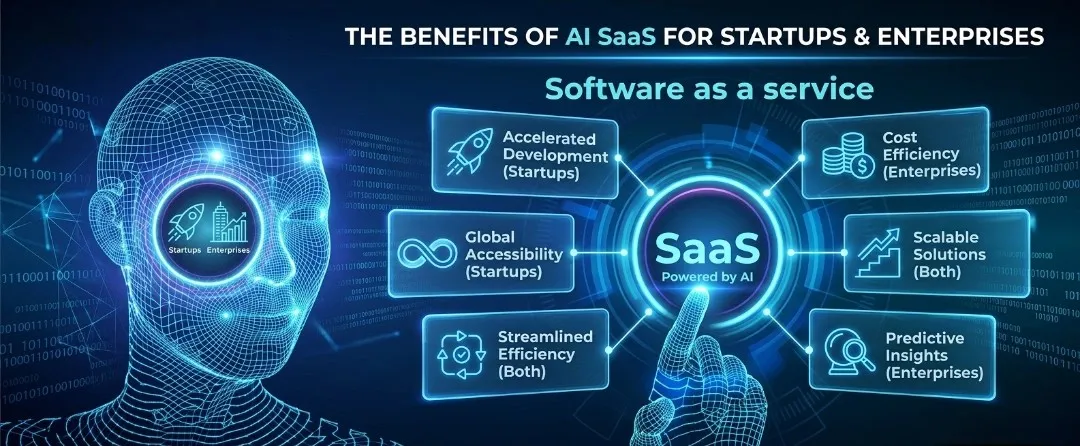

Artificial Intelligence and SaaS, commonly known as Software as a Service, are transforming the way businesses operate across the global technology market. From startups in Silicon Valley to large enterprises managing international operations, companies are increasingly adopting AI-powered SaaS solutions to improve productivity, reduce operational costs, and accelerate business growth.
Search trends in the United States and international markets show growing interest in topics such as:
How AI SaaS improves business efficiency
Why startups are investing in AI-powered tools
How enterprises use AI for scalability and automation
Whether AI SaaS solutions are worth the investment
For businesses operating in the software and IT sector, AI SaaS is no longer viewed as an experimental technology. It has become a strategic business advantage that supports smarter decision-making, improved workflows, and sustainable long-term growth.
What Is AI SaaS?
AI SaaS refers to cloud-based software platforms that use artificial intelligence to automate tasks, analyze data, improve customer experiences, and optimize business operations.
Unlike traditional software systems, AI SaaS platforms continuously learn from data and user interactions, helping businesses become more efficient over time.
Examples include:
AI-powered customer support systems
Automated marketing platforms
Predictive analytics tools
Intelligent workflow automation software
AI-driven project management systems
Why AI SaaS Is Growing Rapidly
Businesses worldwide are adopting AI SaaS because it combines two major advantages:
Accessibility through cloud technology
Intelligent automation powered by AI
According to a report, the global AI software market is expected to exceed $300 billion in revenue within the next few years, showing the increasing reliance businesses have on AI-driven platforms.
Research founds that organizations implementing AI technologies reported productivity improvements ranging from 20% to 40% depending on industry and operational structure.
These figures highlight why both startups and enterprises are accelerating AI SaaS adoption.
Benefits of AI SaaS for Startups
Lower Operational Costs
One of the biggest challenges startups face is managing growth while controlling expenses. AI SaaS platforms reduce the need for large in-house infrastructure and extensive manual operations.
Instead of investing heavily in servers, maintenance teams, and custom systems, startups can subscribe to scalable cloud-based AI tools with lower upfront costs.
Research indicates that cloud-based SaaS adoption can reduce IT infrastructure costs by up to 30%.
Faster Decision-Making
AI-powered analytics tools help startups analyze customer behavior, market trends, and operational performance in real time.
This allows founders and teams to:
Make data-driven decisions faster
Identify opportunities earlier
Reduce uncertainty during growth stages
For startups competing in fast-moving markets, speed and clarity are critical advantages.
Improved Productivity and Team Focus
AI SaaS platforms automate repetitive tasks such as:
Scheduling
Reporting
Customer support
Data organization
Workflow tracking
By reducing repetitive manual work, teams can focus on innovation, strategy, and business growth.
This improves:
Employee focus
Work dedication
Overall operational efficiency
Benefits of AI SaaS for Enterprises
Scalable Global Operations
Large enterprises require systems that can handle complex operations across multiple departments and locations. AI SaaS platforms provide scalable infrastructure capable of supporting international business growth.
Cloud-based AI systems allow enterprises to:
Expand quickly into global markets
Improve cross-team collaboration
Maintain operational consistency
This is especially important for companies serving US and international customers.
Enhanced Customer Experience
Modern customers expect personalized and fast digital experiences. AI SaaS platforms help businesses deliver:
Intelligent recommendations
AI-powered customer support
Predictive customer insights
Faster response times
According to research 73% of customers expect companies to understand their unique needs and expectations.
AI-powered SaaS helps enterprises meet these demands efficiently.
Better Data Management and Analytics
Enterprises generate massive amounts of data daily. AI SaaS platforms process and analyze this data far more efficiently than traditional systems.
Benefits include:
Predictive forecasting
Performance monitoring
Risk identification
Smarter business planning
Companies using advanced analytics strategies often outperform competitors in profitability and customer retention.
How AI SaaS Supports Modern Work Culture
Reducing Burnout Through Automation
One of the most overlooked benefits of AI SaaS is its impact on employee well-being. By automating repetitive tasks, businesses reduce mental overload and improve work-life balance.
Employees spend more time on:
Strategic thinking
Creative problem-solving
Meaningful collaboration
This creates healthier and more sustainable work environments.
Supporting Remote and Hybrid Teams
Global businesses increasingly rely on distributed teams. AI SaaS platforms support remote collaboration through:
Automated communication systems
Smart project tracking
Real-time productivity insights
AI-powered workflow management
This helps teams remain productive regardless of location.
Common Questions Businesses Ask About AI SaaS
Is AI SaaS Only for Large Companies?
No. Startups and small businesses benefit significantly because AI SaaS reduces infrastructure costs and improves operational efficiency.
Does AI SaaS Replace Employees?
AI SaaS is designed to automate repetitive tasks, not replace human creativity, leadership, or strategic thinking.
Is AI SaaS Secure?
Most leading AI SaaS providers invest heavily in cloud security, compliance, and data protection standards.
Why the US and Global Markets Are Investing Heavily in AI SaaS
The United States remains one of the largest adopters of AI SaaS technologies due to strong digital transformation initiatives across industries including:
Healthcare
Finance
Retail
Logistics
Software development
At the same time, global markets are rapidly adopting AI-powered business systems to remain competitive and scalable in a technology-driven economy.
Conclusion
AI SaaS is reshaping how startups and enterprises operate by improving efficiency, reducing costs, supporting scalability, and enhancing productivity. For businesses in the software and IT sector, AI-powered SaaS solutions are becoming essential tools for sustainable growth in both US and international markets.
As technology continues evolving, businesses that strategically adopt AI SaaS will be better positioned to innovate, compete globally, and build stronger operational foundations for the future.