SCHEDULE A CALL

The idea of an "AI employee" once sounded like something from a science-fiction movie. Today, businesses are having a much more practical conversation: What work can AI actually handle, and where should humans remain in control?
AI agents are changing this conversation. Unlike traditional software that waits for a person to click a button or enter information, AI agents can interpret instructions, work through multiple steps, use connected systems, and complete tasks with limited human intervention.
This shift is attracting attention from businesses across the United States and global markets, particularly companies looking to improve productivity, reduce repetitive work, and create more efficient digital operations.
But AI automation is not simply about replacing people. The bigger opportunity is to redesign workflows so that AI handles repetitive execution while employees spend more time on decision-making, creativity, customer relationships, and strategic work.
What Does "AI Employee" Actually Mean?
An AI employee is not literally a human worker. The term generally describes an AI agent or group of connected agents that can perform specific business tasks with some level of autonomy.
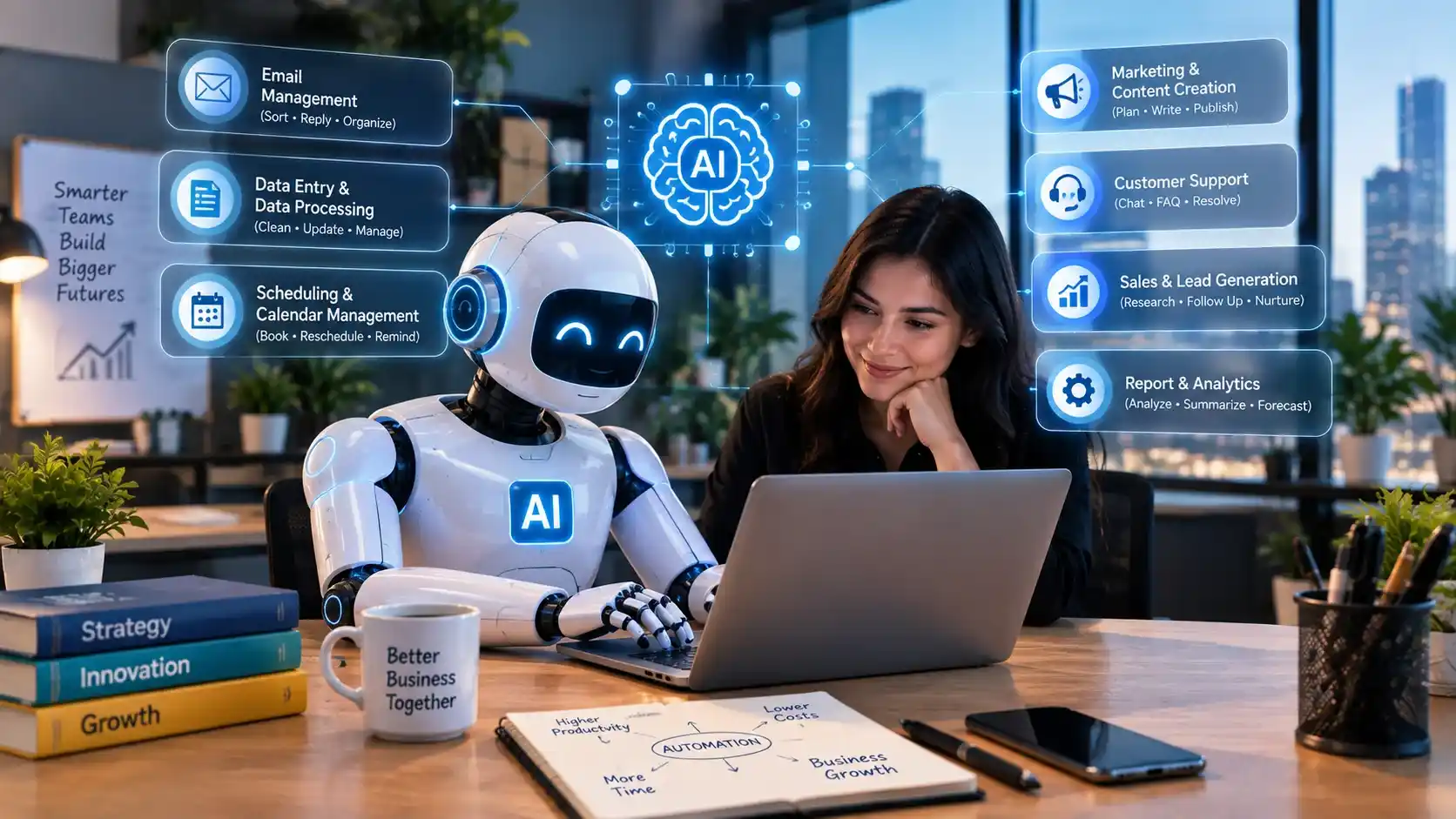
For example, an AI agent could:
Read incoming customer requests
Classify support tickets
Update CRM records
Prepare reports
Analyze business data
Draft responses
Schedule routine activities
Monitor operational systems
Assist with software development
Move information between connected applications
The important difference is that traditional automation usually follows predefined rules, while AI agents can interpret context and handle more flexible workflows.
Deloitte's 2026 research found that 85% of surveyed companies expected to customize AI agents for their specific business needs. At the same time, only 21% of organizations planning agentic AI deployments reported having a mature governance model.
That gap explains why businesses need to think about AI adoption as both a technology and management challenge.
What Businesses Can Actually Automate
Not every business activity is suitable for complete automation. The strongest starting point is usually work that is repetitive, structured, data-heavy, or time-consuming.
1. Customer Support
Customer service is one of the clearest areas for AI automation.
AI agents can handle common questions, identify customer intent, search knowledge bases, and route complicated issues to human representatives.
For example, an online retailer could use an AI agent to answer questions about:
Order status
Shipping
Returns
Product availability
Account information
Human employees can then focus on unusual or sensitive customer situations.
This approach can improve response speed without removing the human role from customer relationships.
2. Administrative Work
Many employees spend significant time on repetitive administrative activities.
AI can assist with:
Document processing
Meeting summaries
Email drafting
Data organization
Report generation
Appointment coordination
Internal information searches
The goal is not simply to make employees work faster. Removing repetitive work can give people more time for tasks requiring judgment and concentration.
3. Sales and Lead Management
AI agents can also support sales teams by helping manage the early stages of the customer journey.
An AI system can review incoming leads, organize customer information, identify potential priorities, and prepare personalized follow-up drafts.
Sales professionals can then spend more time speaking with prospects instead of manually updating systems.
For software businesses, this can be particularly useful when CRM systems, websites, email platforms, and analytics tools are connected into a single workflow.
AI in Software Development
The software industry is another area experiencing significant changes.
AI coding agents can help developers generate code, review existing code, identify potential problems, write tests, and work through development tasks.
McKinsey's 2026 global AI research found that around 2 in 10 organizations were scaling software coding agents, with the figure reaching 31% among larger enterprises. The same research found that 32% of respondents said their organizations had decided not to purchase at least one software product or feature because they believed it could be built internally using agentic coding tools.
This does not mean software developers are becoming unnecessary. Instead, their role can shift toward architecture, problem-solving, product decisions, code review, security, and quality control.
AI Can Automate Tasks, But Should It Automate Decisions?
This is where businesses need to be more careful.
Automating a repetitive task is very different from allowing an AI system to make a high-impact business decision without human oversight.
For example, automatically categorizing support tickets may involve relatively low risk. Automatically approving a financial transaction, terminating an employee relationship, or making a sensitive customer decision can involve much greater consequences.
Businesses should therefore separate:
Tasks AI can execute
from
Decisions humans should supervise
This distinction becomes increasingly important as AI agents gain access to more business systems.
IBM's 2026 research found that only 11% of surveyed technology leaders said their organizations were completely prepared for the scale of AI agent deployment.
The Human Role Is Changing, Not Disappearing
The rise of AI employees is changing what people spend their working hours doing.
Instead of manually completing every step, employees may increasingly:
Define objectives
Review AI output
Handle exceptions
Make strategic decisions
Communicate with customers
Solve complex problems
Improve business processes
Microsoft's 2026 Work Trend Index describes this shift as AI and agents taking on more execution while people gain more room to direct work, make decisions, and own outcomes. Its research analyzed productivity signals and surveyed 20,000 AI-using workers across 10 countries.
This makes human focus even more important.
How AI Automation Can Improve Workplace Focus
Constant repetitive work can consume attention that employees could otherwise use for creative and strategic tasks.
When businesses automate appropriate workflows, teams can spend more time on work that requires human judgment.
This can help reduce:
Manual data entry
Repetitive reporting
Routine communication
Unnecessary context switching
Time spent searching for information
The result is not simply more automation. It can create a work environment where people have greater opportunity to focus on meaningful tasks.
Microsoft's research found that organizational factors such as culture, manager support, and talent practices accounted for more than twice the reported AI impact of individual factors, at 67% versus 32%.
In other words, giving employees AI tools is only one part of the equation. Businesses also need processes and workplace cultures that help people use them effectively.
What Businesses Should Not Automate Blindly
AI automation should not begin with the question, "What can we automate?"
A better question is:
"Which workflow creates unnecessary manual effort while remaining appropriate for AI assistance?"
Businesses should be cautious about automating activities involving:
Sensitive Personal Decisions
Tasks involving employment, financial decisions, healthcare, or other sensitive areas may require stronger human oversight and appropriate controls.
High-Risk Business Decisions
AI can provide analysis and recommendations, but important decisions may require human accountability.
Complex Customer Relationships
AI can support customer service, but difficult negotiations, complaints, and emotionally sensitive situations often benefit from human involvement.
Why AI Governance Matters
As AI agents become connected to business systems, governance becomes increasingly important.
Companies need to consider:
Who can authorize an AI agent?
What systems can it access?
What information can it use?
What actions can it take?
When must a human approve an action?
How are mistakes detected?
How are activities monitored?
Deloitte's August 2026 research found that only 5% of surveyed organizations considered their business processes highly prepared for AI agents, while just 15% had scaled orchestrated, cross-functional multi-agent adoption.
This suggests that successful AI adoption involves much more than selecting an AI platform. Businesses also need appropriate processes, security, governance, and employee training.
What This Means for US and Global Businesses
For US businesses and international companies competing in digital markets, AI agents could change how software, customer service, operations, sales, and internal processes are organized.
The companies adopting AI responsibly are not necessarily trying to automate everything.
Instead, they are identifying specific areas where AI can:
Reduce repetitive work
Improve response times
Connect disconnected systems
Support employees
Analyze large amounts of information
Improve operational consistency
This approach allows businesses to experiment while maintaining human oversight.
Common Questions About AI Employees
Will AI Employees Replace Human Employees?
AI can automate certain tasks and change job responsibilities, but task automation should not be confused with the elimination of entire occupations.
McKinsey's analysis found that currently demonstrated technologies could theoretically automate activities representing about 57% of US work hours. The research specifically notes that this is not a forecast of job losses. Many jobs could instead change as individual tasks become automated.
Are AI Agents Only Useful for Large Companies?
No. Smaller organizations can also use AI agents for focused workflows such as customer support, lead management, document processing, scheduling, and internal knowledge management.
The important factor is choosing a use case where automation solves a real business problem.
Should Every Business Adopt AI Agents?
AI adoption should be based on business needs, risk, available data, technical infrastructure, and expected value. Using AI simply because it is popular can create unnecessary complexity.
Conclusion
The rise of AI employees is changing the meaning of automation.
Businesses are moving beyond simple rule-based systems toward AI agents capable of handling more flexible, multi-step workflows. Customer support, administration, sales operations, data processing, and software development are among the areas where businesses can already explore practical AI automation.
However, the most important question is not how much work a company can remove from human hands. It is how technology can help people spend more of their time on work that requires judgment, creativity, communication, and strategic thinking.
For businesses in the United States and global markets, the next stage of AI adoption will likely depend on finding that balance: automate where technology adds value, keep humans involved where judgment matters, and build the systems needed to make both work together effectively.