SCHEDULE A CALL
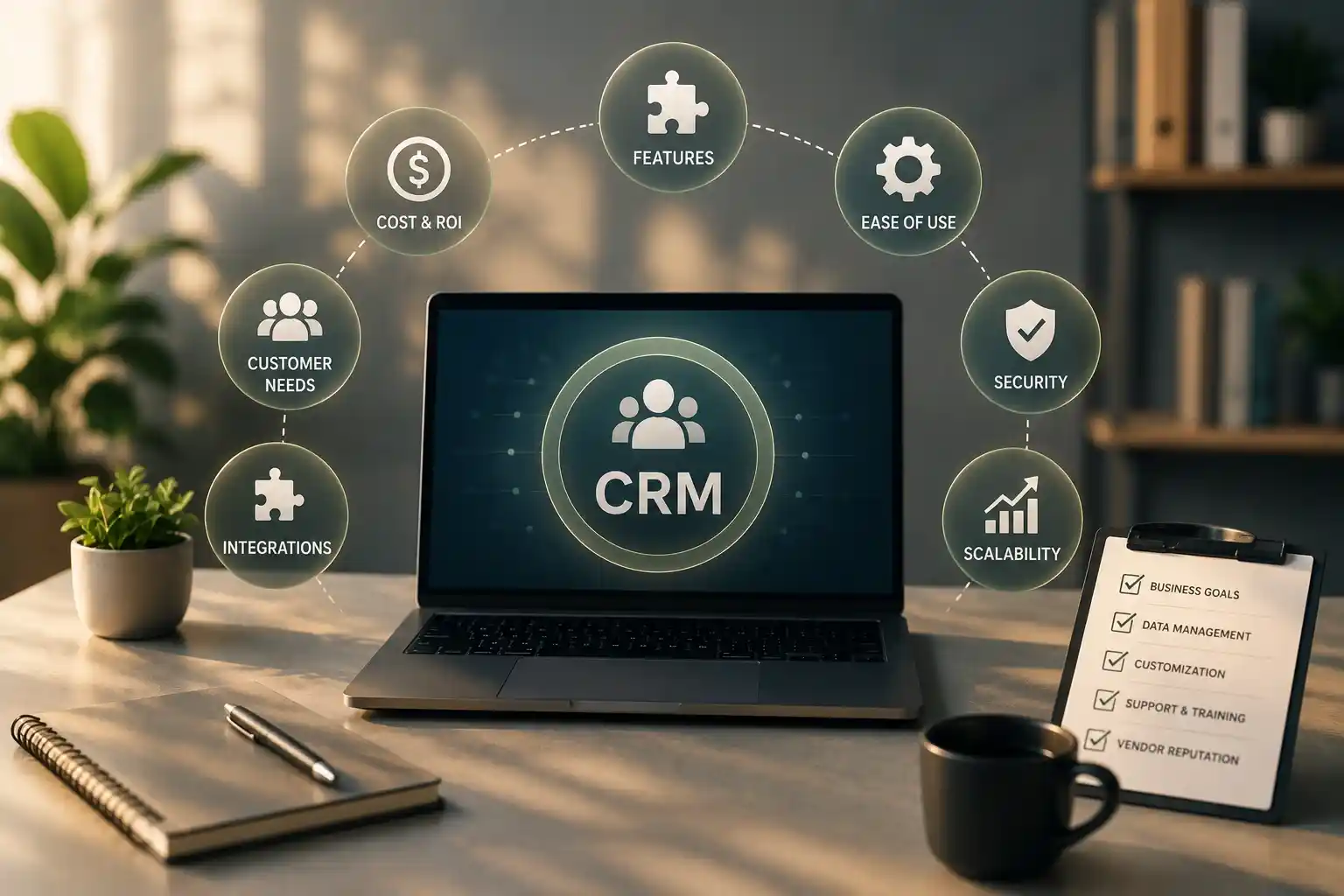

Choosing customer relationship management software is no longer just an IT decision. For growing businesses, a CRM can influence sales, marketing, customer service, data management, team productivity, and even long-term business strategy.
That is why one question is becoming increasingly important for business owners, technology leaders, and IT teams:
“What should I consider before investing in CRM software?”
There are hundreds of CRM platforms available, ranging from simple tools for small businesses to highly customizable enterprise systems. The challenge is not finding a CRM. The real challenge is finding one that fits the way a business actually works.
Research from Gartner indicates that worldwide end-user spending on CRM is expected to continue growing at a 14.4% compound annual growth rate through 2029, driven partly by generative and agentic AI.
With CRM technology becoming more intelligent and connected, businesses need to look beyond basic contact management before making an investment.
What Is CRM Software and Why Does It Matter?
CRM stands for Customer Relationship Management. CRM software helps businesses organize and manage interactions with current and potential customers.
A modern CRM can bring together information related to:
Customer profiles
Leads and opportunities
Sales activities
Marketing campaigns
Customer service
Communication history
Business analytics
Workflow automation
Instead of keeping customer information across spreadsheets, emails, messaging platforms, and disconnected databases, a CRM can create a more centralized view of the customer journey.
However, having more features does not automatically mean having a better CRM. The right solution is the one that supports business goals without creating unnecessary complexity.
1. Start With Your Business Requirements
Before comparing CRM vendors, businesses should first identify what they actually need.
Ask questions such as:
What problems are we trying to solve?
Are sales teams struggling to manage leads?
Is customer information spread across different systems?
Do managers lack visibility into sales performance?
Are customer service teams spending too much time searching for information?
Which processes should be automated?
According to Info-Tech Research Group, CRM selection should begin by defining target capabilities across areas such as marketing, sales, and customer service, followed by prioritizing requirements and evaluating the architecture of the CRM environment.
This step prevents businesses from buying technology simply because it has an impressive feature list.
2. Consider Scalability Before You Invest
A CRM should support the business not only today, but also as it grows.
A small company might begin with a few sales representatives and a limited customer database. Over time, that same company may have multiple departments, thousands of customers, international operations, and more complex workflows.
Before investing, consider whether the CRM can handle:
More users
Larger customer databases
Additional departments
New sales channels
International operations
More integrations
Increasing automation requirements
A scalable CRM can prevent businesses from having to replace their entire customer management system when they reach the next stage of growth.
3. Look Closely at Integration Capabilities
A CRM should not operate as an isolated system.
Modern businesses typically use multiple technologies for accounting, email marketing, customer support, ecommerce, communication, analytics, and project management. If these systems cannot communicate effectively, employees may have to enter the same information repeatedly.
This can create unnecessary work and increase the risk of errors.
TechTarget recommends evaluating technical factors such as compatibility with other software, integration capabilities, usability, reliability, and support when selecting CRM software.
For IT teams, integration should therefore be treated as a core requirement rather than an optional feature.
4. Evaluate AI and Automation Features
AI is changing what businesses expect from CRM platforms.
Modern CRM systems can use AI to assist with tasks such as:
Lead prioritization
Sales forecasting
Customer insights
Automated data entry
Personalized communication
Workflow recommendations
Customer service assistance
Research published in the Journal of Innovation & Knowledge examined 64 scholarly articles and 24 interviews with CRM experts and identified data management, multichannel integration, and tailored services as important dimensions of AI-powered CRM capabilities.
However, businesses should not choose a CRM simply because it includes AI.
The better question is:
“Does the AI solve a real problem for our business?”
Useful automation should reduce repetitive work and help employees concentrate on higher-value activities.
5. Think About Data Security and Privacy
CRM platforms can contain highly valuable business information, including customer identities, contact details, purchasing history, communication records, and sales information.
That makes security an essential part of the buying decision.
Businesses should investigate:
Data encryption
Access controls
User permissions
Authentication options
Backup procedures
Compliance requirements
Data storage locations
Security monitoring
This is particularly important for US businesses and companies serving international customers because privacy and data protection requirements can vary across markets.
Security should never be treated as something to investigate after signing a contract.
6. Calculate the Total Cost of Ownership
The subscription price is only one part of CRM investment.
Businesses should also consider:
Implementation
Data migration
Customization
Employee training
Integration
Maintenance
Technical support
Additional users
Premium features
A platform with a low starting price can become expensive if it requires extensive customization or additional third-party services.
Comparing total cost of ownership provides a much clearer picture than comparing monthly subscription prices alone.
7. Prioritize User Experience and Adoption
Even the most advanced CRM can fail if employees do not want to use it.
A complicated interface can create frustration, slow down workflows, and encourage employees to return to spreadsheets or personal systems.
This is why usability matters.
Employees should be able to understand:
Where customer information is located
How to update records
How to manage tasks
How to track opportunities
How to find important reports
CRM selection should involve the people who will actually use the platform. Info-Tech similarly emphasizes that IT should work closely with marketing, sales, and customer service when defining the CRM vision.
8. Consider Customization and Flexibility
Every business has different processes.
A CRM that works perfectly for one organization may not fit another without customization.
Look for flexibility in areas such as:
Workflows
Fields
Dashboards
Reports
User permissions
Automation
Integrations
Customer journeys
At the same time, too much customization can create technical complexity. Businesses should aim for a practical balance between flexibility and simplicity.
9. Check Vendor Support and Long-Term Direction
CRM software is a long-term technology investment. The vendor's future direction matters almost as much as its current features.
Before choosing a platform, research:
Customer support options
Product update frequency
Integration ecosystem
Security practices
AI development strategy
Documentation
Training resources
Vendor stability
The CRM market is evolving quickly, particularly as AI becomes more deeply integrated into customer management platforms. Everest Group notes that CRM platforms are increasingly becoming broader operating layers connecting sales, marketing, service, customer data, analytics, automation, and AI-enabled workflows.
A platform's ability to evolve can therefore have a major impact on its long-term value.
10. Measure Success Before Implementation
Before implementing a CRM, establish clear goals.
For example, a company might want to:
Improve lead conversion
Reduce manual data entry
Increase sales visibility
Improve customer response times
Reduce duplicate customer records
Improve forecasting
Increase team productivity
Having measurable goals makes it easier to determine whether the CRM investment is actually delivering value.
It also keeps teams focused on business outcomes rather than simply completing a software implementation.
Common Questions About CRM Investment
Is CRM Software Worth It for Small Businesses?
It can be, especially when customer information and sales activities become difficult to manage manually. However, small businesses should choose a solution that matches their actual needs rather than paying for unnecessary enterprise features.
Should a Business Choose a Cloud CRM?
Cloud-based CRM platforms are increasingly common because they can simplify access, updates, scalability, and integration. However, businesses with specific regulatory or data requirements may need to evaluate hybrid or other deployment options.
Is AI Necessary in a Modern CRM?
AI is becoming increasingly valuable, but it should serve a clear purpose. Businesses should evaluate whether AI features can improve productivity, customer engagement, forecasting, or automation rather than selecting a platform based purely on AI branding.
How Long Does CRM Implementation Take?
Implementation time varies depending on company size, data complexity, customization, integrations, and employee training requirements. A simple implementation may be relatively quick, while a complex enterprise deployment can require a much longer roadmap.
Final Thoughts
Investing in CRM software is ultimately an investment in how a business manages relationships, information, and growth.
The best CRM is not necessarily the platform with the largest feature list. It is the system that fits the organization's processes, integrates with its technology environment, protects its data, supports its employees, and can grow alongside the business.
For technology-driven companies, the decision becomes even more important as AI, automation, analytics, and customer data increasingly converge within CRM platforms.
By evaluating business requirements, scalability, integration, security, AI capabilities, usability, cost, and long-term vendor support before making a decision, businesses can choose CRM technology with greater confidence and build a stronger foundation for sustainable growth.


.webp)